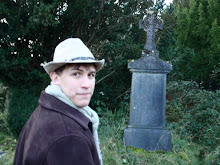
Today was simple. I arose to cranberry juice (coffee is out until the stomach can fathom it). After Greek vocabulary, pieces of exegesis (seeing all of the parts, and none of the whole), and further progress on an outline, I made for my auto so as to pick up my younger cousin from school. What a mind, honestly. I pray that he becomes a writer, because then I could bounce ideas off of him, and perhaps they will make it into one of his books.
Then again, I could write one; though not while my stomach is in this state. How did Calvin do it (ulcers breed unwanted profanity in my thoughts, and surely spoil the appetite)?
Anyway, we read Lewis' The Great Divorce. He was inquisitive: "If the narrator honestly sees himself as a ghost, how can he possible grasp at the flower or the blade of grass?" or "How can they feel the pangs of hard grass, when they have no bodies?" These types of questions prompted great dialogue. And let me just say that the lad is eschatologically solid, which is encouraging. No pie-in-the-sky, "cloud-walkin' after I die," for this guy. He and Lewis would get along well. There are weighty matters milling about in his mind. Oh, to learn from a child.
Dinner tonight was at the home of our church's worship leader. His family is wonderful and very hospitable. Pizza was on, salad, the like, and variegated chatter on past life, hopes, and directions. The conversation climaxed in a full-on jam session – two guitars and a dobro. The latter was a true proficient, with much experience in the art of bluegrass. My favorite. So many possibilities, so much potential. Even in this heart, seemingly hard and numb of feeling as of late, there yet resides a spark for the innovative steel-string, the rhythm and blues, and a stalwart melody with which we sail the stars in strokes of harmony.
Decisions are never weightless. They don't float or meander in thin speculation or theory. They bear consequences, burdens, and sometimes children (no cause for alarm, 'tis merely for the literary effect). Life is a great gift, and we are a generation, bent on milking it for all its worth, without the least sense of gratitude... or responsibility. I stake my claim among the worst of these. I only regret the years of wasted choices... corporately. This is apparently what "makes man great, that gives him stature with the gods" (Steinbeck: Lee, in East of Eden; long before Mumford & Sons). It may also be his very own demise. Medieval man believed that the stars played an intricate part in providence (so, we thank the lucky ones). "Poppycock!" say we. But perhaps modern man sees too little in the stars (i.e. mere gases and chemicals) and too much in the mind: a fickle playground, indeed. Perhaps there are entire worlds, an otherness of sorts, that we neglect (I refer to Lewis' The Discarded Image for justification of these last few lines, which may be mere nostalgia; or perhaps something more).
You do have your choices. Make them, but remember to tread lightly upon the grounds of our collective conscience. We just might fool ourselves with our empirical magic and analytical sorcery, and perhaps we are more engrossed in a tradition than we like to admit.
But I cannot abide these thoughts long, for it is nearly bedtime. Books just came in the mail, and perhaps a Johnny Flynn vinyl... Huzzah!
At times I wonder if I cannot read. I am slow at it, and the words dissolve quite gradually, mixing in with any thoughts that might occupy my mind at a time. In this way, I try to encounter the author on his own terms, but I'm positive that many of my own thoughts impose upon the text. It's perplexing when a mind finds itself thinking in so many directions at once. The body slows down because it knows full well that so much of its energy is focused on internal matters.
In some instances, this is helpful.
In others, it is problematic, lacking a certain discipline.
Even still, I find that I find that I rejoice in the thoughts that connect. I'm all about making a connection.
C. S. Lewis is capturing my imagination once again literarily, philosophically, and even theologically. With The Great Divorce and TheAbolition of Man behind me, I am making way through Screwtape Letters. Upon their completion, it is further up and further in with Problem of Pain, Surprised by Joy(which I have not read), and Out of the Silent Planet. Such works will always hold a special place in my heart, and as I hope to pursue a very interdisciplinary way of life and of teaching, I hope in many respects to imitate such a mind.
The weight of glorious matters hangs heavy on my heart, yes, in part because I am rediscovering a childhood literary hero, but also in light of Advent, and the season that implants the glorious incarnation in the minds of so many (Yes, such a matter should constantly drive those who are a part of the 'New Humanity'; however, the nature of the season as symbol is not to be diminished).
A man of no mean age sits in his wheelchair, in the well-to-do retirement home, listening to children demonstrate various proficiencies at the piano, as they play, in the spirit of the holiday, many a well-known jingle. He hardly speaks, for he barely can. He mumbles, as if to himself, something of passing significance in between songs, yet it does not seem that he is fully aware. It may be that his attention is devoted to the music. He fixes his eyes into space and seems, from my perspective, lost in thought, or simply lost. He hums along in dissonant groans to familiar tunes, but any words are incoherent. Others applaud the children, and to this also he is oblivious.
A young lad, no more than nine, marches dutifully to the piano, and nervously performs a rather broken semblance of the song, "Hark the Harold Angels Sing." The song reaches a welcomed climax to a nearly indistinguishable tune, yet the last melodic chords are seamless. At this, the elderly gentleman, disregarding propriety, clearly intones in full voice, "Hark the Harold Angels sing, Glory to the new-born King!"
I cannot help it: my eyes are averted to the man's countenance. He smiles boyishly, gives a single clap of his hands, and fiddles with his fingers, as if all joy collects before him instantly as dust, so that he might capture and savor it. I saw then a young lad, many years earlier, in the living-room of his household, sitting at the piano in his father's lap while these fingers, enraptured with the joy of learning their first carol, play tentatively, dwarfed by the hands of his teacher. The thought was simple, and not elaborate. How could I know if they were true memories, they certainly were not mine. There may have been a tear in the man's eye, my eyes could not see clearly.
I am not entirely sure what prompted this sudden outburst from the elderly man who did not otherwise speak. I do not particularly care to know for sure, but I venture a guess: Advent draws hearts to hear a wondrous news. The reality of Advent is that, whether consciously or unconsciously, men and women of all ages sing of it every year in these parts. Granted that Victorian, romanticized imagery imbues every song for those who do not grasp their weight. That is why the weight must remain.
It is not merely about keeping Christ in Christmas (As if winter solstice was sacred among all other days). Christ cannot be removed from any realm of this present day, for he reigns, firmly established, and "of the increase of his government and of peace their will be no end." All who are in Christ are established thus, and the principalities and powers shall not prevail. It is ultimately about the reality of all things wrong being made right because of incarnation (ultimately through resurrection). If we lived constantly in light of this, the truest of realities, putting off such frivolous, polar extremes as idolatry and iconoclasm would not so rend the Body.
For we believe that we have died, been buried, and are raised with him who formed the New Humanity. So, we enter into this identity at our baptism, in symbol, but also in truth, as this baptism is nurtured in our lives. We believe also that flesh and blood, having been broken and spilled, were given for the redemption of man, the conformity of many sons to glory. So also, we partake of these, through the elements, in spirit and in truth: in remembrance, yes, but also in reality pertaining to substance.
We live a reality as Christians. It is a mythical reality, filled with types, symbols, forms, and narrative, but history and myth coincide in unison, preparing the way of the Great King, who shall return, in flesh and blood, to rule the 'High Countries' of new creation. Legend will no longer give way to intellectual criticism, but intellect, will, body, soul, and passion shall be transformed fully into the likeness of Christ. Advent must look to all of these things, in symbol and in reality alike.
"All shall be well, and all shall be well, and all manner of things shall be well." ~Julian of Norwich
I have never been more aware of my own Hamlet complex than at the present. True, I've always known myself to be a rather indecisive chap, but lately I am vexed beyond all belief, straying into doubt concerning pursuits of this life. I have often been of the aesthetic mindset: namely, that meaning is found in beauty (and ultimate beauty is found in Christ, the firstborn of the New Man). I chose initially to pursue theological studies because I saw, at one point at least, a radiance emanating from the scriptures, particularly regarding theological truth. I still long to see and partake in the glorious movement of Yahweh, in history, as a part of the body of Christ. But is this something I study?
I believe that the truth of Christ extends into all realms. Literary metaphors, poetry, syllogisms, and dialectic can be put the task of conveying the truth that reflects the weighty words of scripture, can't they? Furthermore, our relationships, when centered in Christ, ought to be transformed into a life-pattern that invites others to behold a new creation.
The conundrum is that I love so many things that I find in this world. Masterfully written stories, the subtleties of well-crafted folk music, and time to sit with friends and settle into simple conversation let me know that I'm alive. Yet, even despite the occasional presence of such wonderful blessings this semester, I feel as if my studies have left me dry, cracked, and worst of all nonplussed and paralyzed.
What do you do with a man who cannot find a foothold in the precipices of these matters?
My friends, I am left suspended in the hope of new creation and a resurrected mind that will face a reality devoid of death, with the time to think, sing, write, harmonize, and love as I ought.
...Though I will not promise much. I had a fine laugh at the few posts prior to these. No more pretensions about metaphysical or philosophical prowess. I don't know that I ever truly possessed such a trait, though I might have fooled myself.
I am currently a student in seminary, though that may change. I am learning that I am, to quote songwriter Johnny Flynn, "born with a love for the wrote and the writ." I long to be a servant with what little I am given.
Dedalus can't be the surname for this fellow any longer (I'm looking into changing the alias). I love so many things literary and narrative, and yet I find myself so captivated by the expanse of the history of our faith. I'm most willing to put aside old debates for new wineskins of charitable historical and theological debate.
Perhaps something of weightier matter will yield fruit of more eternal value.
Studies at the moment:
Greek Exegesis
Biblical Hebrew
A rough survey of church history
A less-than-exemplary class on ethics
The following is an interview of a man whose work (namely what little I have read of his work concerning the church, culture, and theological ramifications thereof) I have come to respect for its insight and candor. The interview is conducted by a pastor that I hold in high esteem as well, through his right division of the word of truth by the grace and power of the Holy Spirit.
Here is the reasoning behind my decision to post this interview:
As artists, writers, speakers, theologians, critics... nay, as HUMANS, we live in the wake of and ride upon the proverbial backs of other individuals, who have gone before us, whether we like it or not. In fact, the notion of and search for the "true" existentialist is, in my mind, quite simply a joke, since even the existentialist relies upon the written works of the likes of Sartre, de Beauvoir, and Kierkegaard, and if they do not, they rely upon other individuals that have had a more personal impact upon their outlook. But the fact is that we find ourselves subject to the thoughts and ideas of our predecessors. We cannot escape our reliance upon heritage and those who have shaped our heritage. We sift through their ideals, their imagery, their practicalities, their nuances, and their convictions and find shards and blemishes alike. The shards, we realize, are those tools by which these individuals have taken what is broken, namely human reasoning concerning the divine and the essentially human, to cut hues and patterns into the symmetry of logic or a rejection of logic in order to make sense of reality. The blemishes are patterns we find which do not accord with reality. Through these patterns, we are endowed with the art of philosophy, and it is by this very broad term that we understand both practical and theoretical matters, which are found in the world that we live in, and which are a part of the human experience. The matter, then, is whether or not we realize our association with such "schools of thought," as it were. We follow such logic and weighing of influences with a matter of choice, either conscious or subconscious, concerning our allegiances to certain mindsets, and we count the cost in identifying with such ideals and subsequently build upon these foundations.
These individuals do not have to be big name philosophers or theologians. They can be relatives in our heritage, psychologists and talk-show hosts on TV, or the latest fiction novelist. The common western man with no interest in delving into philosophical or theological roots builds upon the foundations of his family upbringing, or the rejection of such principle; his peers, as well as his enemies for antithesis; his culture, which is force-fed to him through media, politics, economy, and the like; and his own conception of what ought to be god in his own mind. But what he does not realize is that his philosophical mindset is shaped by the filtered application of thinkers such as Hegel, Nietzsche, and Kant; his economic mindset is shaped by Adam Smith and his proteges; and his theological foundation is the classic liberal humanism, which is expounded from the pulpit of the world.
The Christian has a difficult time, then, as he is faced with being a work or (for our consumer mindset) a product of the Spirit as well as the temptation to be a product of the culture. Obviously, there are certain facts we cannot deny: that the Christian man thinks in terms, and grapples with ideas, of this culture. But as theologians, we supersede philosophers in this way. We must think in terms outside of culture as well, acknowledging a God that supersedes culture, and yet is somehow guiding and ordaining culture as he sees fit.
I have discussed some of these ideas in a previous post, and I have also written a painfully brief discourse on this idea of Christ's message within culture for a theology class I took this past semester.
I will discuss more later, for rather than to save this post without publishing and lengthen it at a later date, I should very much like to get the above interview on here post haste, as part of a statement as to which side I take in all of this debate. The postmodern man, as well as my former philosophy teachers, and even a few of those I know, love, and respect very dearly (maybe even you few who read my blog), shall perhaps disrespect me for taking such a side, or even for taking a specific side at all. To those who would prefer that I not take a side, I say this: the only "side" I claim to purport is that which adheres to scripture, that which adheres to the doctrine found in those scriptures, and that which founds itself in the Spirit of truth, through Christ Jesus, his death and resurrection, and the promise of salvation which he has ensured through such sacrifice. So, for those of you who claim to hold to that, I am still on your side. Call it enlightenment (for you open theists and humanists), call it an act of my free will (for you Arminians, whom I do love), or call it as I call it: providence, God's sovereignty, etc. In any case, I have been introduced to the biblical and cultural teachings of the likes of these men, and if you would like to know where I am coming from to spare yourself from yet another wearisome post (as if this was not already becoming one), listen to these men talk very briefly about culture and the state of certain theological debates, and perhaps explore more.
Also note certain websites that grace the top of my browser in my bookmark list: www.reformed.org, www.monergism.com, www.challies.com, www.thegospelcoalition.com, www.theresurgence.com. The last of these is the website from which I acquired this interview.
These are the things that I have been studying lately, and along with developing a kind of aesthetic foundation from which to draw an artistic means of communicating the truth that I see, I have been in prayer about how these thoughts and ideas translate into practical application into my personal life. Perhaps, I will bring in some poetry later, perhaps some prose. Hopefully, if I can find the time and endurance to complete them, a few plays. For now, though, I am studying. I am learning. I am the work of art that God is shaping. Bear with me please, and I shall with you. "Just because I'm losing, doesn't mean that I'm lost," and Tolkien said it beautifully: "Not all who wander are lost." But let us wander, shall we, within the parameters of those things we know to be true: Christ's death, resurrection, and promise of salvation to all who believe in Him.